
Markets & Society Journal
The Markets & Society journal aims to promote the development of interdisciplinary research of consequence grounded in mainline political economy and to promote the analysis of historical and contemporary issues in the social sciences through a variety of disciplines, methods, and strategies.
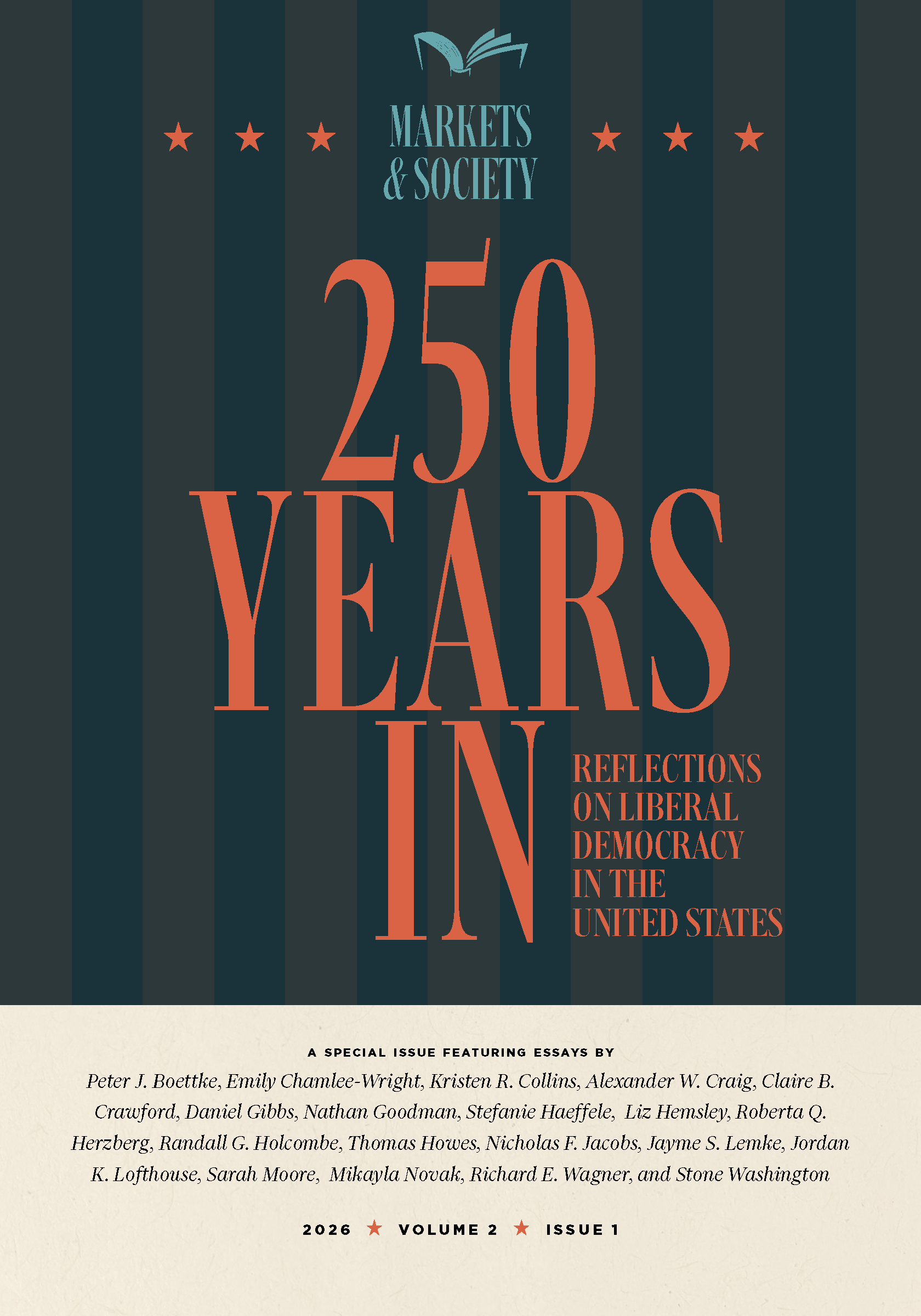

This volume examines the 250-year American experiment with liberal democracy, highlighting both its shortcomings and its remarkable achievements. The essays explore how the nation’s founding ideals of liberty, equality, justice, and self-government shaped American institutions and inspired the expansion of political and economic rights over time. Although the volume addresses the exclusion and oppression experienced by many groups, it also emphasizes the role of constitutional limits, democratic institutions, civic associations, social movements, and citizen activism in correcting injustice and extending freedom. Drawing on perspectives from economics, political science, history, sociology, and political philosophy, the contributors consider how Americans have challenged abuses of power, created new forms of self-governance, and renewed the country’s commitment to liberal ideals. Taken together, the essays present the American democratic project as incomplete but resilient, and explore how civic engagement, institutional reform, and self-governance might help sustain and renew it.
Volume 1, issue 2 engages the ideas and arguments in three books—Kenneth Boulding’s Stable Peace (1978), Elise Boulding’s Cultures of Peace: The Hidden Side of History (2000), and Christopher J. Coyne’s In Search of Monsters to Destroy: The Folly of American Empire and the Paths to Peace (2022). The common theme across these books is the desire to understand various aspects of peace between and among people. Understanding peace, with all of its nuances and complexities, is central to understanding human well-being and flourishing. The contributions to this symposium shed light on the many aspects of peace across interdisciplinary divides and explore the implications of policies that promote or interfere with stable peace.

In volume 1, issue 1, Virgil Henry Storr and Stefanie Haeffele introduce the journal as a space for and across a variety of disciplines, utilizing a variety of methods, to explore key questions about the nature of markets and the potential of society. Then in a series of keynote addresses, economist Peter J. Boettke explores the possibility and likelihood of social cooperation in a cosmopolitan liberal order, economist Deirdre N. McCloskey discusses the historical importance of liberalism in spurring human flourishing, and philosopher Kwame Anthony Appiah speaks to the key role that museums play as collections of human attainment and the complex nature of heritage and ownership of the arts. There are also five original research articles exploring the themes of liberalism, family, crises, repugnant markets, informal markets, and technological change.